



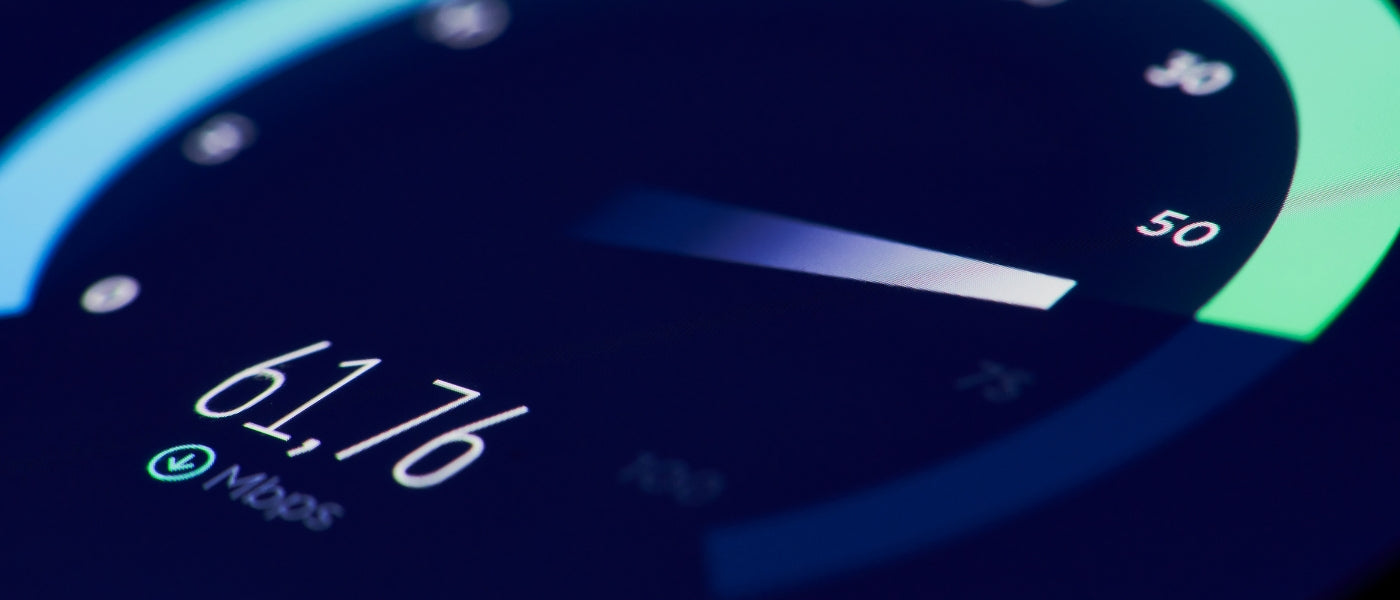
It's a moment everyone has experienced: you hit download, the speed indicator starts at zero, slowly climbs, and after several seconds—sometimes more than a minute—it finally stabilizes at something reasonable. If you're lucky.
The most baffling part is that this behavior has no relation to your contract. You might have 600 Mbps or 1 Gbps and still see that acceleration ramp every time you start a download, a video call, or an online game. The problem isn't with your provider. It's in how the signal travels from the router to your device.
Wi-Fi isn't a connection: it's a constant negotiation
When your device connects to Wi-Fi, it doesn't just receive the signal and that's it. What actually happens is a continuous negotiation between the router and the device: what channel it uses, how much interference there is at that moment, how many other devices are competing on the same frequency, how strong the signal is.
All of this is constantly recalculated. And at the beginning of each transmission, the network protocol has to learn the actual quality of the connection before fully opening the tap. This is known as the slow-start phase of the TCP protocol, combined with the inherent instability of Wi-Fi.
The result is that speed gradient you see at the beginning: 10 Mbps, 50 Mbps, 200 Mbps... until it stabilizes, if it stabilizes at all.
With PLC adapters, the problem is even worse. The electrical wiring in the house has variable noise: an appliance turning on, the time of day, the neighbor's electrical installation. The speed not only takes longer to reach its maximum, but it also fluctuates constantly.
What changes with Actelser plastic optical fiber
Plastic optical fiber transmits data via light pulses through a dedicated physical cable. It doesn't share any medium with other devices. It has no electromagnetic interference. It doesn't depend on the state of any electrical installation.
This has a direct and very specific consequence: the connection doesn't need to negotiate anything at the start. The channel is clean, stable, and always the same. There are no variations depending on the time, network load, or physical obstacles between the router and your device.
That's why the Actelser system achieves a latency of less than 1 ms and, just as importantly, delivers 100% of the available bandwidth from the very first data packet. There's no acceleration ramp. No waiting. When the download starts, it's already at maximum speed.
Why latency matters more than it seems
Most people associate ping with video games. In reality, it affects absolutely everything you do on the internet.
When you open a webpage, the browser makes dozens of requests to the server. Each one waits for a response before continuing. With high or variable latency, these waits accumulate, and the page loads slowly even if you have fast fiber.
When you're on a video call, latency determines whether your voice arrives in real-time or with a delay that leads to those awkward conversations. With 1 ms of latency on the local network, that part of the problem disappears.
When you upload a large file to the cloud, latency affects the rate at which the transfer protocol can open its sending window. With high latency, the protocol is conservative and slow. With 1 ms latency, it opens to its maximum from the start.
The difference you notice in everyday life
With a Wi-Fi or PLC connection, the usual behavior is this: the first few seconds of any transfer are slow, the speed fluctuates depending on what's happening in the environment, and in rooms far from the router, the situation progressively worsens.
With Actelser plastic optical fiber, that behavior disappears. The speed you get next to the router is the same speed you get at the end point of the installation. No losses along the way, no slow start, no fluctuations.
You don't need to contract more megabits. You need the megabits you already have to arrive completely, stably, and from the very first second.
Who benefits most
Remote work and video calls. A connection that takes time to stabilize results in the first few seconds of a call having terrible or pixelated quality. With 1 ms latency and constant speed, the call starts clear from the first frame.
Online gaming. Ping isn't just a number on a screen. It's the difference between seeing what's happening on the server in real-time or with a delay. A ping of less than 1 ms on the local network eliminates the part of the delay that depends on your home installation.
Downloading and uploading large files. The TCP protocol's slow start resolves much faster when the connection is stable. What might take tens of seconds with Wi-Fi to reach maximum speed, happens in the first second with plastic optical fiber.
4K Streaming. Buffers exist precisely to compensate for the instability of connections. With a stable connection without fluctuations, content starts immediately and without interruptions.
You don't need more megabits, you need them to arrive well
Actelser plastic optical fiber doesn't improve your contract. It does something more valuable: it makes the contract you already have truly work, in any room, with less than 1 ms latency and no acceleration ramp. Installation without construction, no complex configuration, compatible with any router and any operator.
You can see all available kits at actelsershop.com.


