



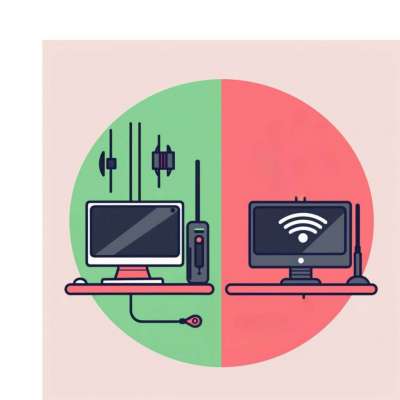
In the world of internet connections, it is common to hear terms like speed and bandwidth. They are often used interchangeably, but in reality, they represent different concepts. Not confusing speed with bandwidth is essential to understand how your connection works and how you can optimize it according to your needs. An effective way to improve the stability and quality of your connection is to opt for wired solutions that allow you to make the most of the available bandwidth without suffering interference, as happens with wireless connections.
Speed vs. Bandwidth: What's the Difference?

Imagine your internet connection is like a water tap. Speed is like the pressure with which water comes out: the higher it is, the faster you fill a glass. Bandwidth is the diameter of the pipe: a wider pipe allows more water to flow at the same time. So, even if the water comes out with a lot of pressure (high speed), if the pipe is narrow (limited bandwidth), not much water can pass through at once. Similarly, for an optimal connection, you need both high speed and ample bandwidth.
Speed
The speed of a connection refers to how quickly data is transferred from the internet to your device and vice versa. It is measured in megabits per second (Mbps) or gigabits per second (Gbps). A higher speed means data arrives faster, which is crucial for activities like downloading large files or streaming high-definition videos without interruptions.
Bandwidth
Bandwidth is the maximum data transfer capacity that your connection can handle at any given time. Think of it as the width of a highway: the more lanes it has, the more vehicles (data) can travel at the same time. However, this does not necessarily mean that each vehicle travels faster.
Why Is It Important Not to Confuse Them?
Confusing these terms can lead to misunderstandings about the actual performance of your connection and how to improve it. For example, you may have a connection with high bandwidth but with limited speed due to factors such as latency or network congestion.
The Value of Wired Connections

Many connection needs are met when we opt for cabling. A fiber optic cable, even if it offers only 100 Mbps, can be more efficient and faster in terms of effective speed than the vast majority of WiFi 6 and even WiFi 7 repeaters. A prominent solution for this type of connection is the Snap Data Basic Plastic Fiber Optic Kit which includes 2 ACT1003 converters and 20 meters of POF cable, ideal for optimizing the network signal in any home or small office without the need for complex construction work.
Advantages of Wired Connections:
- Stability and Reliability: Wired connections are less susceptible to interference and offer a constant signal. Actelser converters and kits ensure stable 1 Gbps transmission over distances of up to 50 meters.
- Lower Latency: Response time is faster, which benefits activities such as online gaming or video conferencing. Actelser offers solutions such as the Snap Data Duplex Plastic Fiber Optic Kit, perfect for covering an entire home with maximum efficiency.
- Improved Security: It is more difficult for third parties to intercept a wired connection, especially when using solutions such as Actelser's POF kits, which integrate high-security converters and cables.
- Consistent Speed: There are no signal losses or fluctuations in transfer speed, ensuring a fluid user experience.
Limitations of Wireless Connections
Although wireless technologies have advanced significantly, they still present challenges:
- Electromagnetic Interference: Other devices can affect the WiFi signal.
- Physical Obstacles: Walls and objects can weaken or block the signal.
- Network Congestion: Several simultaneous connections can saturate the available bandwidth.

Practical Applications: When to Choose Wired over WiFi?
- Remote Work and Videoconferencing: To ensure a stable connection without cuts. Actelser kits such as the Snap Data Teleworking Kit include an additional WiFi module to maximize coverage in work areas.
- Online Gaming: Where low latency is crucial.
- High-Definition Content Streaming: To avoid buffering and maintain image quality.
- Data Security: In environments where confidentiality is essential.
Understanding the difference between speed and bandwidth allows you to make informed decisions about how to configure your network and what type of connection is most suitable for you. Do not confuse speed with bandwidth: although both are related, they represent distinct aspects of your internet connection.
Opting for a wired fiber optic connection, such as the solutions offered by Actelser, can offer you a more efficient and faster experience than relying exclusively on wireless solutions, even if these promise higher bandwidths. At the end of the day, what really matters is how that capacity translates into real performance and stability for your daily activities. If you are looking for a complete solution, consider the Plastic Fiber Optic Kits, which allow complete coverage in large homes and complex spaces without the need for additional repeaters.


