



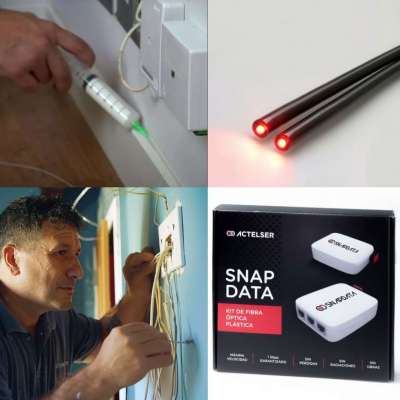

Two technologies stand out for their ability to significantly improve high-speed coverage: Fiber to the Room (FTTR) and Plastic Optical Fiber (POF). We explore each of these options in detail, including their characteristics, advantages, and installation considerations, to help you decide which is the best solution for your needs.
Fiber to the Room (FTTR)

FTTR technology aims to extend high-speed internet coverage to all rooms in a house. FTTR installation is carried out externally along baseboards and door frames, making the cabling visible but avoiding major construction work.
Movistar's FTTR service has a lifelong monthly cost of 9.90 euros, plus an activation fee of 120 euros. It includes a WiFi 6 router and all the necessary kit for system installation. The offer is available in Madrid and Barcelona. The commitment period is 24 months, with a penalty of up to 100 euros for early cancellation, and additional costs if you choose to keep the equipment after ending the service.
Advantages:
- Broad Coverage: Guarantees high-speed connection in every room with speeds of up to 1 Gbps.
- Easy Access: Does not require major construction work for installation.
Disadvantages:
- High Cost: FTTR service can cost over 357 euros in two years, including monthly fees and mandatory commitment.
- Only for Movistar customers.
- Currently only in Madrid and Barcelona.
- 24-month commitment contract.
- Extra monthly fee of 9.90 Euros.
- Visible Cabling: Can be aesthetically intrusive as it is not hidden within existing structures.

Plastic Optical Fiber (POF)

On the other hand, Actelser's Plastic Optical Fiber is presented as an innovative and less invasive alternative. This type of fiber is installed inside existing electrical conduits, which minimizes cable visibility and the inconveniences associated with more traditional installations.
Advantages:
- Accessible Cost: Actelser's POF has a much lower initial cost, starting from 75 euros, and does not involve additional fees or permanence.
- More Discreet: It can be completely hidden, easily integrated into existing infrastructure without the need for construction work.
- Self-installable.
- Freedom to choose Operator: Allows choosing any internet service provider, offering flexibility to the user.
Disadvantages:
- POF is a bit thicker (though not much), so if it is run externally like FTTR, it may be more visible.
- There is no app to monitor the installation with a mobile, although it's not essential, some people like to have that.

Installation and Maintenance
Both technologies offer solutions to improve connectivity in hard-to-reach places within homes. The choice between FTTR and POF will depend on several factors including budget, desired ease of installation, and home aesthetics. While FTTR offers a quick and broad coverage solution, POF stands out for its cost-effectiveness and less visual impact.
If you are looking for a more economical and flexible option, Actelser's Plastic Optical Fiber could be the ideal solution.
Example of Plastic Optical Fiber installation


