




1. Technology
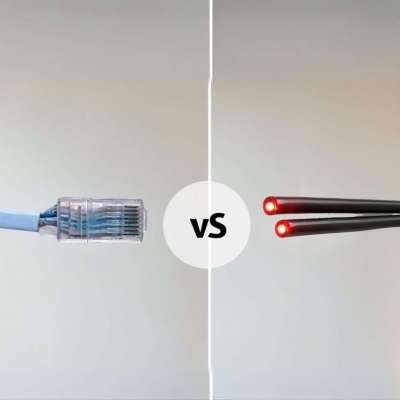
Fiber Optic: Uses pulses of light to transmit data, allowing for significantly higher transmission speeds and over much greater distances without signal degradation.
Copper Cable: Transmits data via electrical signals, which can be susceptible to electromagnetic interference and signal loss over longer distances. However, advanced categories of copper cable, such as Cat 6a and Cat 7, can achieve and exceed 10 Gbps speeds over short distances.
2. Speed and Stability

Fiber Optic: Offers speeds that can reach up to 1 Gbps and beyond, suitable for high-demand applications such as 4K video streaming, online gaming, and large data transfers. Fiber is also more stable, with lower latency.
Copper Cable: Although some advanced categories of copper cable can offer speeds over 10 Gbps (such as Cat 6a, Cat 7, and Cat 8), it can generally experience speed fluctuations and higher latency, especially under heavy loads or over long distances.
3. Price
Fiber Optic: Can be more expensive to install initially, especially if no prior infrastructure exists. However, long-term operating costs may be lower due to less maintenance and better efficiency.
Copper Cable: Can be less expensive initially, especially if visual appearance is not a concern. However, it's important to note that running copper cable through electrical conduits is an illegal practice, although it is sometimes done.
4. Recommendations
For Businesses and Demanding Users: Fiber optic is generally the best option due to its superior speed and reliability. It is ideal for businesses that rely on constant and fast connectivity.
For Regular Home Use: Copper cable may be sufficient, especially in homes that do not require the high speeds of fiber optic. However, for homes with multiple users or devices that consume a lot of bandwidth, fiber optic can be a prudent investment.
In summary, the choice between fiber optic and traditional cabling will depend on your specific requirements for speed, stability, costs, and future expansion needs. Fiber optic, although more expensive initially, offers a more robust and future-proof solution for most users and applications. However, advanced copper cable technologies can also be a viable option in certain contexts, especially where infrastructure is already in place.


