



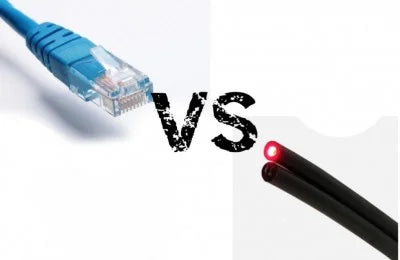
Plastic Optical Fiber is making a strong entry into many home installations. But is it really worth an investment higher than Wi-Fi repeaters and even some PLCs? In the following article, we detail and explain in which cases Plastic Optical Fiber is a unique, highly reliable alternative that ultimately pays off. An option with unique advantages that positions itself as a long-term solution for the new era of 4K TV and gaming.
The alternatives available to us are classified as follows:
- Wi-Fi Repeaters (and Wi-Fi mesh)
- PLC Repeaters
- Traditional Cabling (Ethernet and Glass Fiber)
Optical Fiber Vs Wi-Fi Repeaters

Comparing Plastic Optical Fiber to Wi-Fi repeaters doesn't make much sense, as their performances are completely different. The Wi-Fi system is an economical and simple solution to install, but with low reliability. It can be suitable when the bandwidth required is not very high and if there are few walls, doors, and other obstacles. However, even under ideal conditions, Wi-Fi repeaters lose a large part of our signal along the way and are capable of transmitting only about 20-30% of the signal they receive. This means that if we pay for, for example, 100 megabits, we will only be able to transmit about 20 megabits, which will fluctuate. It's always better than nothing, but optimizing connectivity is out of the question. This method is often the first solution many of our clients apply initially until, over time and with increasing demand in their homes, they discard this method due to its inconsistent quality.
If we consider that with plastic fiber we will be utilizing 100% of the contracted connectivity, the comparison is irrelevant, as the two systems address very different needs.
Plastic Optical Fiber VS PLC repeaters

PLCs are a method that evokes both love and hate in equal measure. In cases where they don't cause problems, satisfaction can be high, as they can transmit considerable bandwidths, up to 40% of what's contracted, but this is not always the case.
The PLC repeater offers unpredictable performance as it depends on the quality, age, and degree of deterioration of the electrical installation. If other devices are plugged into the electrical network, they will also significantly affect it, creating interferences that deteriorate and can even disable the operation of the PLCs.
Compared to PLC repeaters, the advantage of Plastic Fiber is also very clear, as a specific cable transmission system is always much more stable and reliable than using the electrical connection used by PLCs.
With PLCs, speeds are not always optimal, interferences can be high, and instability is common and always subject to the quality of the electrical line.
Faster and easier installation than with UTP cables (CAT5 and CAT 6)
It is important to note that it is expressly prohibited by the common telecommunications infrastructure regulation (ICT) to run Ethernet cable through electrical conduits. Therefore, a reputable professional cannot advise or operate against current legislation. Despite this, we encounter many cases where these guidelines have been disregarded, which poses a significant risk.
In this regard, the main advantage of Plastic Optical Fiber (POF) over Ethernet cables is that it is installed through the existing electrical conduits in the house, while wiring the house with UTP cables (Cat 5e and Cat 6, for example) requires opening the wall and installing specific conduits or visible wall trunking.
If telecommunications conduits are available, the main drawback in installing UTP type cables will be the thickness and lack of malleability of the cable, which makes it difficult or impossible to introduce into existing conduits. This is where Plastic Optical Fiber is very advantageous: thin, malleable, and robust.

Why can Plastic Optical Fiber be run through electrical conduits?
Since Plastic Optical Fiber (POF) transmits light, is not an electrical conductor, and has a reduced thickness, it does not cause problems when sharing the same conduits as other electrical cables. For this reason, it is authorized by the Ministry of Industry.
Download Ministry document here
The main advantage of Plastic Optical Fiber (POF) over Ethernet cables is that it is not copper, it transmits light, and it is allowed to be installed through the existing electrical conduits in the house, whereas to wire a house with UTP cables (Cat 5e and Cat 6, for example) requires opening the wall to create a new conduit or installing visible trunking, or in the worst, aesthetically displeasing cases, "stapling" it to the wall. Those who decide to run it through electrical conduits, we insist, are not permitted by law, entail inherent risks of creating magnetic fields that cause signal coupling, which degrades and causes losses.
Additionally, you need to have the crimping pliers and know how to use them very well, because data is lost at the connections.
The combination of Plastic Fiber with local Wi-Fi emitters multiplies performance by 7

Telefónica conducted official tests comparing the performance of Wi-Fi Mesh systems with a Plastic Optical Fiber installation combined with Wi-Fi emitters at each point. What was found is that what is gained in simplicity when installing a Wi-Fi Mesh is lost in performance, as even with this type of connection, significant losses occur. In its tests, Telefónica concluded that the combination of network points with Plastic Fiber (POF) connected to Wi-Fi emitters at each point multiplies the Wi-Fi speed available to the user throughout the house by 7. This type of installation also greatly improves latency, the delay experienced by the user when connecting to the network, which is very important for online gaming. If the interconnection between terminals is via Wi-Fi, the latency is considerably higher than if the interconnection is via POF.
(see Teleworking Pack)
Are cheaper Plastic Optical Fiber alternatives bought in China?
Actelser's Snap Data is a technology developed and manufactured entirely in Spain since 2019 under European standards, guaranteeing the highest speeds.
On Amazon, you can find cheaper Chinese-made devices with only one Ethernet port, but they have a transmission speed of 100 Mbps. Actelser's Plastic Optical Fiber supports up to 1Gb with three RJ45 port converters.


